

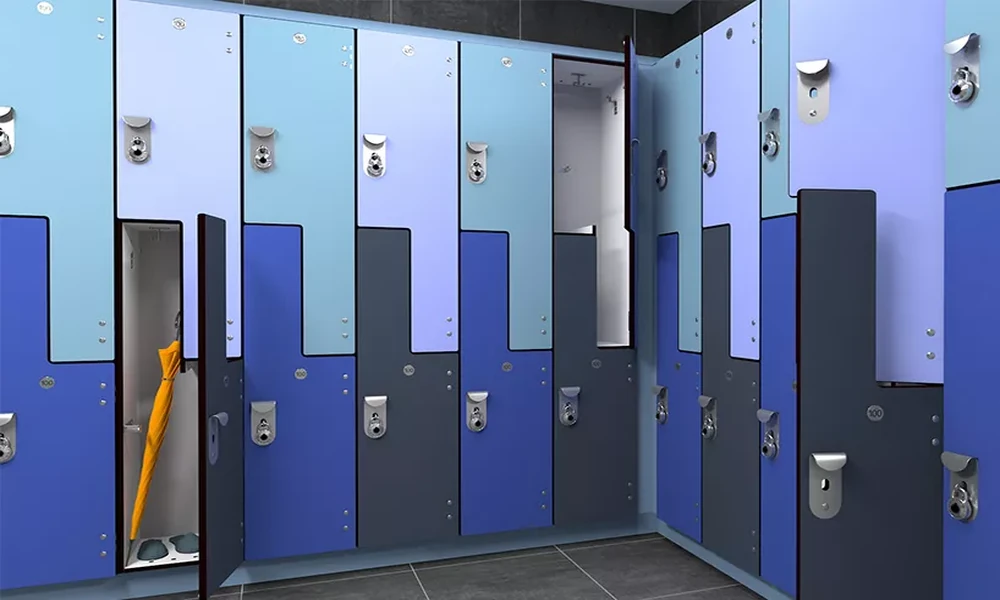
Z-style lockers offer facilities with limited floor space a way to provide 2 full-length hanging compartments in the footprint normally used by 1 single-tier locker. The interlocking Z-shaped doors allow each user to hang a full garment while sharing the same width of wall.
Employment in U.S. warehousing and storage has grown substantially over the past decade (U.S. Bureau of Labor Statistics).
What is a Z-style locker?
A Z-style locker is a double-tier locker in which the compartments interlock in a Z pattern rather than stacking directly on top of each other. Each compartment has an upper portion on one side and a lower portion on the other, so each user gets a space tall enough for a coat or uniform to hang.
The limitation Z-style lockers solve
The design addresses a common limitation of standard 2-tier lockers. Traditional stacked lockers divide height in half, which leaves each compartment too short for full-length garments. The Z layout solves that problem while keeping the capacity advantage of a double-tier locker.
Which lines include Z-style configurations
Z-style configurations appear across steel, solid plastic, and phenolic lines, including a 2-person Z-locker in a powder-coated steel collection built with 16-gauge louvered doors, frames, and bottoms (ASI Storage Solutions).
Why do Z-style lockers save space?
Z-style lockers save space because they double storage capacity per unit of wall length compared with single-tier lockers while preserving usable hanging height. Facilities can serve twice as many users in the same footprint.
Space-saving advantages
- 2 users per locker width instead of 1
- Full-length hanging space in each compartment
- A built-in bench-height shelf in each compartment in some designs
- Fewer locker banks required for the same headcount
- More room left for circulation and benches
For facilities with tight rooms and growing headcounts, this efficiency can avoid the cost of expanding or reconfiguring a locker room.
Where are Z-style lockers most useful?
Z-style lockers are most useful in employee changing areas, athletic facilities, and public safety buildings where users need to hang uniforms or street clothes and floor space is limited. They also suit health clubs and campus recreation centers with high membership counts.
Change room storage rules
Federal sanitation rules address storage for street clothes and protective clothing in change rooms where protective clothing is worn because of contamination risk (Occupational Safety and Health Administration). In facilities where employees change into uniforms, Z-style lockers provide separate compartments that make better use of available space.
How do Z-style lockers compare with other configurations?
Z-style lockers compare favorably with single-tier and stacked multi-tier lockers when users need hanging space and capacity at the same time. The trade-off is that each compartment is narrower than a single-tier locker of the same width.
Configuration comparison
- Single-tier lockers give 1 user full height and full width
- Standard double-tier lockers give 2 users half-height compartments
- Z-style lockers give 2 users full-length hanging space in a shared width
- Multi-tier lockers of 3 to 6 tiers serve more users with small compartments for bags and books
The right choice depends on what users store. Coats and uniforms point toward single-tier or Z-style lockers. Backpacks and small personal items suit multi-tier lockers.
What materials are available for Z-style lockers?
Z-style lockers are available in powder-coated steel, solid plastic, and phenolic, allowing specifiers to choose the material that fits room conditions. Steel suits dry environments, while plastic and phenolic suit humid areas.
What should facilities consider before choosing Z-style lockers?
Facilities should consider the size of items users store, the number of users per shift, accessibility needs, and door swing clearance before choosing Z-style lockers. Narrower compartments work well for uniforms but may not suit bulky gear.
Evaluation checklist
- Typical items stored, including bags, boots, and equipment
- Headcount at peak shift overlap
- Accessible compartment needs for users with disabilities
- Room depth for door swing and bench placement
- Locking method for each compartment
Mixing configurations is a common strategy. A room might combine Z-style lockers for general staff with single-tier lockers for users who store equipment and accessible lockers placed within reach ranges.
How do Z-style lockers affect locker room layout?
Z-style lockers affect locker room layout by reducing the linear wall length needed for a given number of users, which frees up floor area for benches, circulation, and accessible routes. Designers can use the recovered space to improve traffic flow during shift changes.
Accessibility in Z-style layouts
Accessibility guidance covers reach ranges, clear floor space, and accessible routes (U.S. Access Board). Planning those elements alongside locker configuration helps a room function well for every user.
How do Z-style lockers handle uniforms and footwear?
Z-style lockers handle uniforms and footwear by providing a tall hanging section for garments and a lower section where boots and shoes can sit below the hanging clothes. The arrangement keeps footwear away from clean uniforms in each compartment.
Fitting issued footwear
Facilities that issue boots or safety shoes should confirm that compartment depth and height fit the footwear employees actually wear. Adding a shelf or hook package inside each compartment helps users separate items and keeps lockers organized between shifts.
What is the long-term value of Z-style lockers?
The long-term value of Z-style lockers lies in their ability to serve more users in the same footprint without sacrificing hanging space. Facilities that anticipate headcount growth benefit from building extra capacity into the original layout.
The value for tight locker rooms
For space-constrained locker rooms, Z-style lockers deliver a practical balance of capacity and usability. They are a straightforward way to make every foot of wall work harder.
