

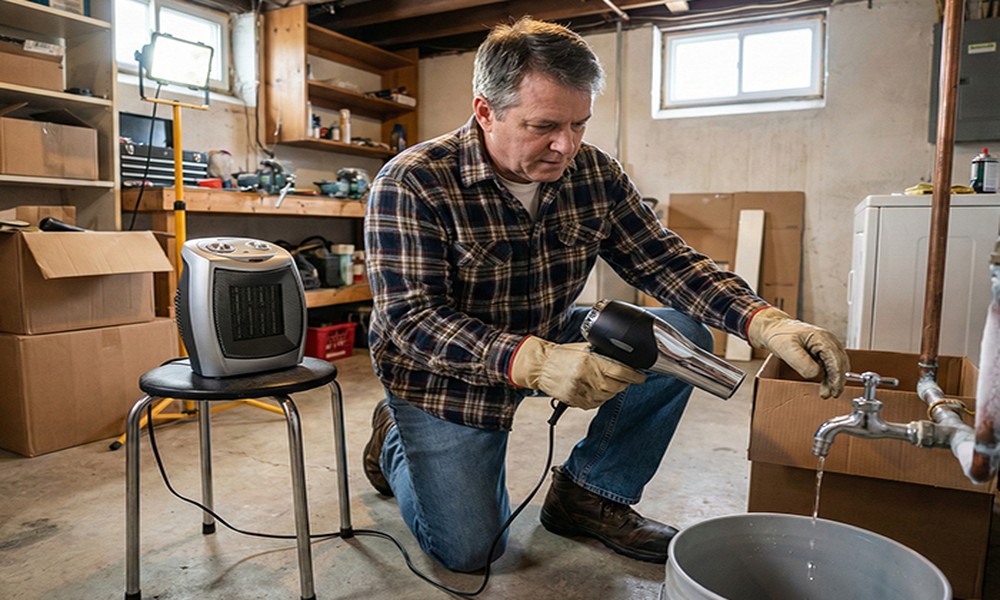
Burley sits in a climate that doesn’t get enough credit for how hard it is on residential plumbing. The Snake River Plain’s high desert conditions mean summer heat that bakes the ground and winter cold that arrives fast and bites hard. Cassia County regularly sees overnight lows that dip well below freezing from November through February, and the region’s wind chill makes exposed pipes feel those temperatures even faster than a thermometer reading suggests. Harris Plumbing NG has worked on homes throughout the Mini-Cassia area long enough to know what that seasonal shift does to plumbing systems that weren’t prepared for it – and the pattern of calls that comes in every January is preventable in almost every case.
Here’s what southern Idaho’s winters actually do to your pipes, what to check before temperatures drop, and when it’s time to call rather than guess.
What Burley’s Freeze-Thaw Cycle Does That Other Climates Don’t
A steady cold that stays below freezing is actually less damaging to plumbing than the freeze-thaw cycling Burley homeowners experience regularly through late fall and early spring. When temperatures drop hard overnight and then climb back above freezing during the afternoon – which happens consistently in October, March, and on unpredictable days in between – pipes go through repeated cycles of contraction and expansion.
Water expands by roughly nine percent when it freezes. Inside a pipe with nowhere for that pressure to go, that expansion doesn’t necessarily burst the pipe at the point of freezing. The pressure buildup travels through the water column and tends to find the weakest point in the system – a joint, a fitting, a section of older pipe that’s already under stress. That’s why a burst pipe from a freeze event often shows up somewhere other than where the ice actually formed, which confuses homeowners who try to trace the source on their own.
Older homes in Burley – and there are a lot of them in the neighborhoods closer to downtown and along the irrigation district areas – tend to have plumbing configurations that made sense decades ago but weren’t built with modern insulation standards. Crawl space pipes with little or no insulation, supply lines running along exterior walls, and hose bib connections that haven’t been properly winterized are the three most consistent sources of freeze damage in the Mini-Cassia region.
What to Inspect Before the First Hard Freeze
Outdoor hose bibs are the first place to start. Standard hose bibs – the threaded spigots on the exterior of the house – aren’t designed to be left connected to a garden hose through winter. The hose holds water in the spigot itself, which can freeze back into the pipe. Disconnecting hoses is the minimum. If the hose bib isn’t a frost-free model (a longer-shanked design that shuts off water inside the heated envelope of the house rather than at the exterior wall), it should either be upgraded or have its interior shutoff valve closed and the bib drained before temperatures drop consistently below freezing.
Homes with irrigation systems connected to the main supply need those lines blown out with compressed air or drained completely. A single segment of pressurized irrigation line that freezes can create enough pressure to damage supply connections inside the house.
Crawl space pipes deserve a walk-through with a flashlight before October ends. Look for supply lines running along the crawl space perimeter – these are most exposed to cold air infiltration, especially if the crawl space venting isn’t adjusted seasonally. In Burley’s climate, crawl space vents that were open all summer to prevent moisture buildup should be closed or covered once nighttime temperatures are consistently below 40 degrees. Pipe insulation on unprotected supply lines isn’t expensive and takes an afternoon to install, but it has to be done before the freeze, not after.
Also check for any sections of pipe near exterior walls inside the house – in cabinets under exterior-wall sinks, in garages where supply lines pass through, and in any unheated spaces like workshops or mudrooms that share a plumbing connection with the main house.
Water heaters work significantly harder in winter. The incoming water temperature from Burley’s municipal supply drops as ground temperatures fall, which means the heater has to do more work to reach the thermostat setpoint. A water heater that was marginally keeping up in September may fall behind noticeably in December. If the unit is more than eight to ten years old, a pre-winter efficiency check is worth doing – looking at the anode rod condition, checking the pressure relief valve, and flushing sediment that’s built up at the bottom of the tank. Sediment acts as an insulating layer between the burner and the water, making the heater run longer and less efficiently, which accelerates wear over winter months when demand is already higher.
The Older Home Factor in Mini-Cassia
A significant portion of the housing stock in Burley, Rupert, Heyburn, and Paul was built in the mid-twentieth century, during the decades when the Magic Valley’s agricultural economy was expanding. Those homes were built with galvanized steel supply pipes in many cases, which have a finite service life. Galvanized pipe corrodes from the inside over time, narrowing the interior diameter and developing weak points that freeze damage is particularly effective at exploiting.
If your home still has galvanized supply lines and you haven’t had a plumber assess their condition, winter is the worst time to find out they’ve failed. The combination of age-related corrosion and freeze-thaw stress is what turns a slow, manageable problem into a flooded crawl space on a February morning.
Homes that were built or significantly renovated in the 1970s and 80s may also have polybutylene pipe – a gray plastic supply line that was widely used until its failure rates prompted a class action settlement in the 1990s. If your home has it, it should be replaced regardless of whether it’s shown problems yet. Cold stress accelerates failure in polybutylene.
When to Call Instead of Handle It Yourself
Some winterization steps are straightforward homeowner tasks: disconnecting hoses, adding pipe insulation to accessible crawl space runs, adjusting crawl space vents. Others require tools, knowledge, or access that make DIY the wrong call.
Blowing out an irrigation system requires the right compressor capacity and an understanding of zone sequencing – too much pressure damages components, too little leaves water in the lines. Replacing a standard hose bib with a frost-free model involves cutting into the supply line and soldering or fitting a new valve, which requires both plumbing competence and the ability to accurately locate the existing shutoff. Flushing a water heater and checking its pressure relief valve is something most homeowners can do with a bucket and a garden hose, but interpreting what the anode rod condition means and whether the tank is worth maintaining requires some experience.
If you notice any of the following before or after a cold snap, it’s time to call a plumber rather than investigate further on your own:
- Water pressure that’s noticeably lower than usual after a freeze
- Discolored water or water with a metallic taste following a cold stretch
- Damp spots on ceilings, walls, or under cabinets that weren’t there before
- A water meter that’s running when no fixtures are in use
- Any section of visible pipe that’s bulging, cracked, or frost-covered
These are signs that something in the system has already failed or is close to it. The damage from a burst pipe that goes undetected for even a few hours in a crawl space or wall cavity goes well beyond the pipe itself – insulation, framing, subfloor, and in some cases the foundation are all at risk when water gets somewhere it shouldn’t be in winter conditions.
Getting Ready Before It Gets Cold: How Harris Plumbing NG Can Help
The calls that come in after a freeze are almost always more expensive and more disruptive than a pre-winter inspection would have been. Burst pipes mean emergency service, water extraction, and often significant repair work on the surrounding structure in addition to the plumbing itself. A water heater that fails in January means cold showers and, in some cases, a wait for replacement parts or equipment during a busy season.
Harris Plumbing NG has been doing this work in Burley and the surrounding Mini-Cassia communities long enough to know which neighborhoods tend to have older galvanized lines, which crawl space configurations are most vulnerable to Cassia County’s cold snaps, and what a pre-winter check on this region’s housing stock actually looks like in practice. That local knowledge isn’t something a national chain can offer.
If you want to go into winter with confidence that your plumbing is ready for whatever the Snake River Plain throws at it this year, call Harris Plumbing NG at 208-431-8633 and schedule a pre-season inspection before the first hard freeze arrives.
